AI Content and SEO in 2026: What the Data Actually Shows

Everyone has an opinion on AI content. We looked at the numbers instead — 600K+ pages analyzed, controlled experiments, and two years of Google algorithm updates.
How much AI content is already out there?
More than you think. Ahrefs analyzed 900,000 newly created web pages in April 2025 and found that 74.2% contained AI-generated content. Only 2.5% was pure AI with no human touch — the vast majority (71.7%) was a mix of AI and human writing.
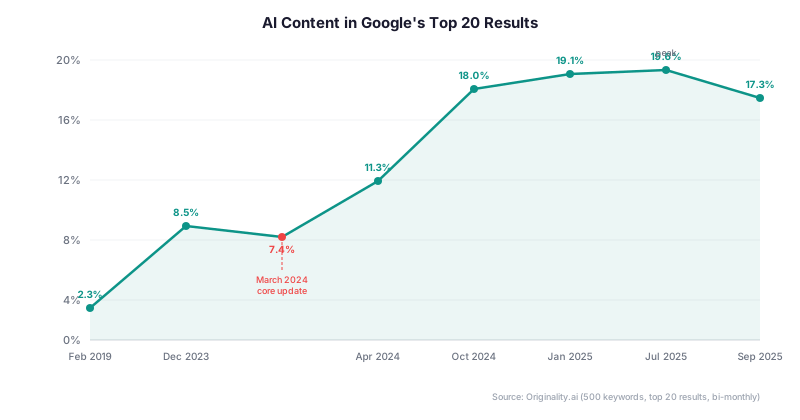
On the ranking side, 86.5% of pages in Google's top 20 contain some level of AI content. Originality.ai has been tracking this since 2019: AI content in top results grew from 2.27% to 19.56% at its peak in July 2025.
The question isn't whether AI content exists in search results. It clearly does. The question is whether it helps or hurts.
Google's actual position: not what you'd expect
Google has been remarkably consistent here. In February 2023, they stated: "Appropriate use of AI or automation is not against our guidelines." In September 2023, they quietly changed "content written by people, for people" to "content created for people" — dropping the "written by people" requirement entirely.
The January 2025 Quality Rater Guidelines made the distinction explicit. AI-generated content gets the Lowest quality rating only when it has "little to no effort, little to no originality, and little to no added value." AI generation alone is not a penalty trigger.
Danny Sullivan put it plainly in December 2025: "Write for humans, not for ranking systems." John Mueller went further, endorsing an article that called most SEO content "digital mulch" — content that exists solely to fill space and appease Google.
The takeaway: Google doesn't penalize AI. Google penalizes low quality. The production method is irrelevant — the output quality isn't.
What the large-scale studies found
Ahrefs ran the biggest study to date: 600,000 pages across 100,000 keywords. The correlation between AI content percentage and ranking position was 0.011 — effectively zero. Being AI-generated or human-written had no measurable impact on where a page ranked.
Semrush's study of 20,000 blog URLs found near-parity: AI content appeared in the top 10 for 57% of queries, human content for 58%. The gap widened slightly at the very top — human content had a +6.2 percentage point advantage in the top 3.
Neil Patel's 68-site experiment told a different story. Human-written content ranked higher 94.12% of the time, with human articles averaging 283 visitors/month versus 52 for AI — a 5.4x difference.
These studies aren't contradictory. They're measuring different things. Ahrefs and Semrush looked at all content regardless of quality. Neil Patel compared raw AI output against professional writers. The variable isn't AI — it's effort.
The SE Ranking experiment: proof in two parts
SE Ranking ran the most controlled experiment available. Two setups, same timeframe (November 2024 to July 2025), very different results.
Part A: 20 new domains, 2,000 AI articles. Minimal human editing, low-to-medium keywords. First month looked promising — 8 sites ranking for 1,000+ keywords, 122,000 impressions. Then on February 3, 2025: complete collapse. All 20 sites lost all traction. Zero recovery.
Part B: 6 AI articles on SE Ranking's established blog. AI-generated with human editing, fact-checking, and transparency disclaimers. Result: 555,000 impressions, 2,300+ clicks. One article reached position #1. Four of six articles got cited in AI Overviews.
Same AI. Same period. Opposite outcomes. The difference: domain authority, editorial oversight, and genuine expertise added on top.
Google's algorithm updates are getting sharper
The March 2024 core update deindexed 837 websites and issued 1,446 manual actions. Every single manually penalized site showed signs of AI content — and 50% had 90-100% AI posts. The combined loss: 20.7 million organic visits per month.
By August 2025, SpamBrain could detect low-quality AI content with 98% accuracy. The December 2025 core update hit even harder: 87% negative impact for mass-produced AI content without expert oversight. Affiliate sites took a 71% hit rate, health content 67%.
The pattern is clear. Google isn't getting better at detecting AI — it's getting better at detecting content that exists for ranking, not for readers.
The bigger threat: AI Overviews are eating your clicks
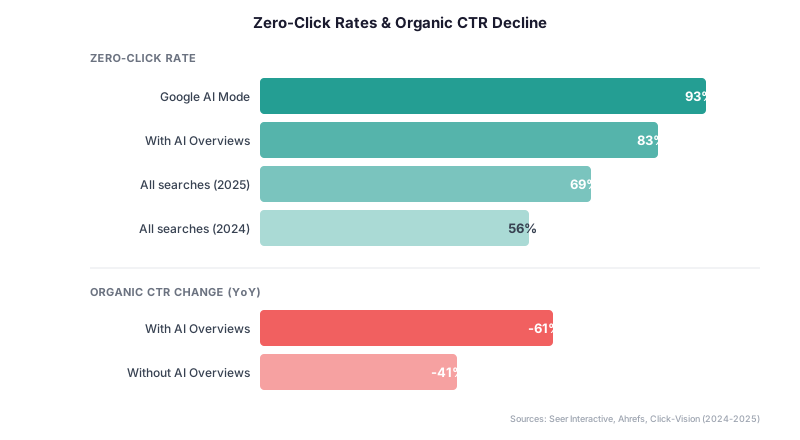
Even if your content ranks perfectly, the clicks might not come. AI Overviews now trigger on 48% of all tracked queries (up 58% year over year), and they're devastating for click-through rates.
Seer Interactive measured it across 3,119 search terms and 42 organizations: organic CTR dropped from 1.76% to 0.61% — a 61% decline — on queries where AI Overviews appeared. Ahrefs found a 58% lower CTR for #1-ranking pages on AIO queries.
Zero-click searches jumped from 56% in 2024 to 69% in 2025. Google's AI Mode takes this further: 93% zero-click rate. Only 8% of users click a traditional link when an AI summary appears.
Publishers are feeling it. Forbes lost 50% of traffic year over year. CNN dropped 27-38%. The median publisher saw a 10% decline. Google Search referrals fell 33% globally.
Your audience is already asking AI instead of Google
According to a November 2025 study, 37% of consumers now start searches with AI instead of traditional search engines. Among Gen Z, that number hits 61%.
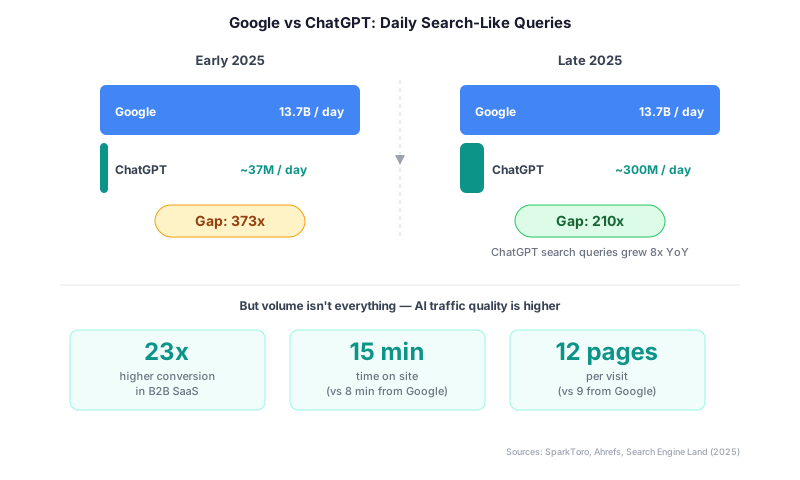
Google still dominates raw volume — 13.7 billion searches daily versus roughly 300 million search-like queries on ChatGPT. But the gap is shrinking: Google was 373x bigger than ChatGPT in early 2025, now it's 210x.
U.S. desktop searches per user fell ~20% year over year. Google isn't losing users — people just search less when they can ask an AI directly. Gartner predicted in 2024 that traditional search volume would drop 25% by 2026. That prediction is tracking.
ChatGPT still sends 190x less traffic than Google. But AI-referred visitors convert 23x higher in B2B SaaS, spend 15 minutes on site (versus 8 from Google), and browse 12 pages per visit (versus 9). The volume is tiny — the quality is remarkable.
What actually works in 2026
The data points to a clear formula:
- AI as a tool, not a strategy. Sites using AI content grew 29% year over year versus 24% for non-AI sites — but only when AI was combined with human expertise. Pure AI mass-production collapses within months.
- Domain authority matters more than ever. The SE Ranking experiment proved it: same AI output succeeded on an established domain and failed on new ones. Brand mentions correlate with AI visibility (0.664) more than backlinks (0.218).
- Freshness and depth win AI citations. Content updated within 3 months gets 2x more AI citations. Articles over 2,900 words get 59% more citations than those under 800. Structure matters: 120-180 words between headings earns 70% more ChatGPT citations.
- Optimize for AI visibility, not just Google. 91.4% of pages cited in AI Overviews contain AI content — but they also have strong authority, fast load times (FCP under 0.4s = 3x more citations), and fresh updates.
The winning approach: use AI to produce faster, but invest the saved time into original research, expert perspectives, and genuine depth that AI alone can't generate.
Does Google penalize AI-generated content?
No. Google's guidelines are clear: AI content is not penalized for being AI content. What triggers penalties is low-quality, unoriginal content published at scale — regardless of how it was produced. The March 2024 deindexing wave hit 837 sites, but all of them were publishing mass AI content with minimal editing. Sites like Bankrate publish AI-assisted content with expert review and face no penalties at all.
How are AI Overviews affecting website traffic?
Significantly. Organic CTR drops 58-61% on queries where AI Overviews appear, and they now trigger on 48% of tracked queries. Zero-click searches reached 69% in 2025. Forbes lost 50% of its traffic year over year, and Google Search referrals declined 33% globally. Even sites ranking #1 are seeing far fewer clicks when an AI summary sits above their link.
Is AI content better or worse for SEO than human-written content?
Neither — the tool doesn't determine the outcome. Ahrefs found a 0.011 correlation between AI usage and rankings (effectively zero). What matters is the quality of the final content. Raw AI output averages 5.4x fewer visitors than professional human writing. But AI content with human editing, fact-checking, and original expertise added performs on par with — or better than — purely human content.
Will AI search replace Google?
Not yet, but the shift is real. Google handles 13.7 billion searches daily versus ~300 million search-like queries on ChatGPT — a 210x gap that was 373x just a year ago. U.S. searches per user dropped ~20% year over year. The volume gap remains massive, but AI-referred visitors convert 23x higher in B2B and spend nearly twice as long on site. Smart businesses are optimizing for both channels.
Need a second opinion?
Let's review your content strategy together
Whether you're considering AI tools or rethinking your SEO approach, we can help you make data-driven decisions.