How "Just One API Call" Snowballs Into a Homegrown Framework

Every vanilla PHP integration starts with a simple promise: "It's just a few API calls." Three integrations later, you've built your own router, error handler, and config manager — and nobody else can maintain it.
"We just need to connect Stripe — a few API calls, nothing complicated." You've probably heard this sentence. Maybe you've said it yourself. And at that moment, it's true: a payment integration in vanilla PHP can be done in a couple of hundred lines. It works. You ship it. Everyone's happy.
Then comes the second request. Then the third. And somewhere around the fourth, you realise you're no longer adding features — you're building infrastructure.
Stage one: "Just a payment form"
A Stripe integration needs an HTTP client, error handling for 20+ error types, retry logic with exponential backoff, and webhook processing with signature verification. You write helper classes, a small config loader, maybe a basic logger. A few hundred lines turn into a thousand. But it works, so you move on.
Stage two: "Now connect the CRM"
Another API, another HTTP client wrapper. Except this one needs OAuth2 token management, refresh logic, and rate limiting. The error handling patterns are different from Stripe's — so you build a "base API client" class to unify them. You've just created a service layer.
The config loader from stage one wasn't designed for multiple integrations. You extend it. Now it reads from environment variables, has per-environment overrides, and supports secrets. You've built a configuration manager.
Stage three: "Add a customer portal"
Users need to log in, upload documents, and see their payment history. That means:
- Authentication — session management, password hashing, "remember me" tokens
- CSRF protection — token generation and verification on every form
- File uploads — MIME validation, path traversal prevention, storage abstraction
- Routing — clean URLs for /login, /dashboard, /documents, plus your existing webhook endpoints
Each of these is a solved problem in any modern framework. In vanilla PHP, each one is a week of work, a week of testing you probably won't do, and a permanent maintenance commitment.
Stage four: "It needs background processing"
Webhook retries, email sending, and CRM sync can't run inside a web request. You need a job queue, a CLI entry point, a cron scheduler. By now, your project has a custom router, middleware pipeline, service container, config manager, ORM-like query builder, background worker, and CLI tool.
Congratulations — you've spent months building a framework. Except yours has zero documentation, zero tests, zero community, and exactly one person who understands it.
This isn't hypothetical — the data backs it up
CAST analysed 10 billion lines of production code across industries in 2025. The findings are uncomfortable:
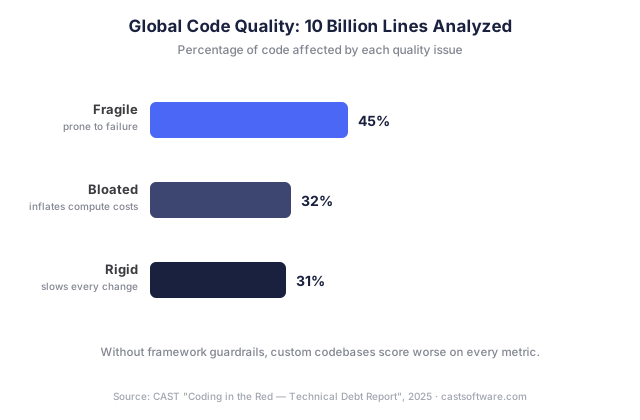
45% of all production code is fragile — prone to failure under unexpected conditions. 32% is bloated. 31% is too rigid to change safely. Custom codebases without framework guardrails, automated testing culture, or community-reviewed architecture score worse on every metric.
And the business cost is real. McKinsey Digital found in 2024 that features on high-debt codebases take 2 to 3 times longer to deliver:
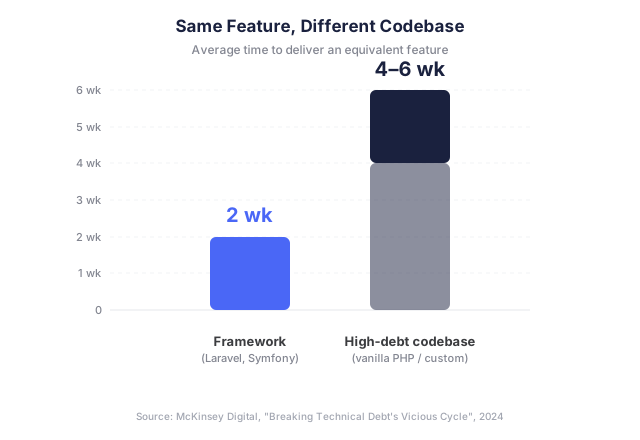
A feature that takes 2 weeks in Laravel takes 4 to 6 weeks on a high-debt codebase. That's not a developer skill issue — it's the cost of fighting your own infrastructure instead of building on proven foundations.
The legacy trap is bigger than you think
According to W3Techs data from March 2026, 43% of PHP-powered websites still run end-of-life PHP versions — no security patches, no performance improvements, no upgrade path.
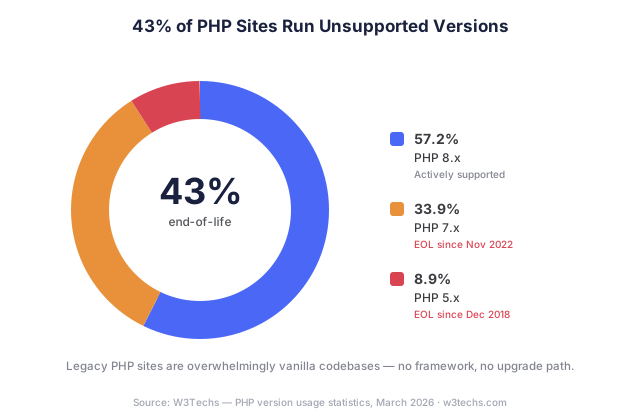
These aren't Laravel or Symfony projects. Framework ecosystems push teams toward current PHP versions through dependency requirements and tools like Laravel Shift. The 43% running EOL PHP are overwhelmingly vanilla codebases — the exact kind that accumulate homegrown infrastructure.
What the ecosystem already solved
Every layer of infrastructure you'd build by hand already exists as a tested, documented, community-maintained package. Packagist — the PHP package registry — has 445,000+ packages with 172 billion total installs. Guzzle alone (the HTTP client you'd reinvent first) has over 925 million downloads.
Here's what a framework gives you out of the box — for free:
- Routing and middleware — URL handling, auth checks, rate limiting, CORS
- Security — CSRF tokens, SQL injection prevention, XSS escaping, encrypted sessions
- Database — query builder, migrations, relationships, connection pooling
- Queues and scheduling — background jobs, retries, cron management
- Testing — built-in test runner, factories, assertions, HTTP testing
None of this is "overkill." It's the minimum viable infrastructure for any project that handles payments, APIs, or user data. The only question is whether you build it yourself or use a version that thousands of developers have already battle-tested.
The real cost isn't technical — it's organisational
When the developer who built your custom infrastructure leaves, the knowledge leaves with them. Onboarding a replacement to a standard framework takes weeks. Onboarding them to a homegrown system with no documentation? That's months — if it works at all.
64% of PHP developers already know Laravel (JetBrains, 2025). That's a hiring pool you can tap into immediately. A custom codebase limits you to developers willing to learn an undocumented system with no career value.
What to do if you're already there
If this sounds familiar, you're not stuck — but the longer you wait, the more expensive the exit becomes. A few practical steps:
- Audit what you've built. Map every piece of custom infrastructure: routing, auth, config, queues. Compare it against what a framework provides natively.
- Stop extending the homegrown system. Every new feature added to custom infrastructure increases migration cost.
- Migrate incrementally. The Strangler Fig pattern — wrapping legacy code with framework components one piece at a time — is safer and cheaper than a full rewrite.
- Get an external assessment. Someone outside your team can spot architectural debt that's become invisible to those living in it daily.
Sounds familiar?
Let's assess your codebase health
If your PHP project has grown layers of custom infrastructure, we can map the debt and plan a realistic migration path — before the next "small integration" makes it worse.