The Marketing "Quick Win" That Deindexed an Entire Site

A company sent its content readers to its own product with one popup — and lost 98% of its search traffic in a day. The popup wasn't the real mistake. Shipping it without a technical review was.
One morning, a site that got about 2,300 visits a day from Google woke up to fewer than 70. Three days later it was under a dozen. No algorithm update, no outage, no drop in content quality. The reason was right there in Search Console: a manual action for spam.
Nobody had bought links or copied content. The team had just connected their content to their product. That one change, made on the business side, wiped out almost all their search traffic overnight.
The point of this story isn't "popups are risky." It's that every marketing change is a bet on how a machine will read your site — and this team never checked the odds.
Here is what that collapse looked like in Search Console:
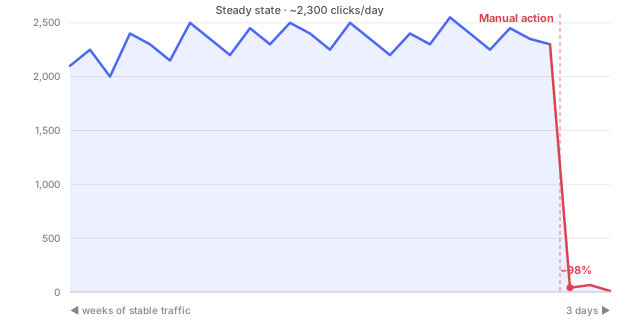
One change, 98% of search traffic gone. Daily organic clicks held steady for weeks, then fell off a cliff the day the manual action hit. Illustrative, based on anonymized Google Search Console data.
What changed
The setup was common. Over a few years, the main site had grown into a large content operation — hundreds of pages built to rank for popular searches. That content brought in almost all the traffic. The product itself lived on a separate subdomain, one click away.
Then the marketing team shipped a quick win. A popup appeared on the content pages and pushed readers straight to the product on the subdomain. Convert the audience you already have. It's the kind of idea that gets a yes in a five-minute meeting, because everyone in the room is measuring conversions, and the popup helps conversions.
Nobody in that meeting was watching the metric that was about to move.
Did the popup even work?
Even on its own terms, it was a weak bet. Industry data on over a billion popup displays puts the average conversion rate around 2% — and falling. The upside was tiny.
The downside wasn't. Google announced in 2016 that, starting in 2017, pages where a popup blocks the content "may not rank as highly" on mobile, where most of these readers were. The tactic already carried an SEO cost before any penalty.
So the team risked the traffic that fed the whole business for a 2% nudge. Said out loud, no one takes that bet. But no one said it out loud.
Why Google issued a manual action
To see the penalty, look at the site the way Google does. A library of useful content is fine. A product on a subdomain is fine. But a popup that funnels readers from the content into a separate product changes what the content is for — and that's exactly what Google's spam rules watch for.
Google's spam policies describe two patterns that fit. Doorway abuse: pages that exist mainly to rank, then send users somewhere else. Scaled content abuse: lots of pages built mainly to rank, not to help — which Google says counts "no matter how it's created," including AI content.
The penalty isn't a small drop. Google says sites that break these rules may "rank lower in results or not appear in results at all" — the manual action known as "pure spam."
And these rules get enforced. Google introduced the scaled-content policy in its March 2024 update and has kept tightening its spam policies since. The popup didn't invent a new problem. It made an old, borderline setup obvious — it showed Google, in one move, what the content was really for.
The real mistake
It's easy to blame the popup and move on. But the popup was a symptom. The real problem: a change with sitewide search consequences shipped without anyone asking one question — how will a search engine read this?
The marketing team optimized for a marketing metric, shipped the change themselves, and never showed it to anyone who could see the technical fallout. The decision made sense inside their frame and was a disaster outside it. Nobody owned the gap between the two.
That's the trap. The changes most likely to hurt your search traffic rarely look technical. They look like marketing ideas — a popup, a redirect, a batch of new pages. So they skip the one review that would catch the problem.
Which changes need a technical check first
You don't need to run button colors past engineering. You do need a short list that never ships without a technical or SEO check, because the downside is months of lost traffic:
Anything that funnels users between properties — popups, interstitials, or overlays that move readers from content to a product, a subdomain, or another site.
Publishing pages at scale — especially AI or templated pages built mainly to rank.
New subdomains or domains tied to your main traffic, and how they link together.
The test is simple: if a change alters what your pages are for, treat it as a technical decision, not a cosmetic one.
The takeaway
A manual action drops you in a day. Getting back takes far longer — a review request can run to a couple of weeks in published recovery cases, and only after you've removed the problem and proven it. Rankings then return slowly, if they fully return at all. Cheap to break, expensive to fix.
Search engines don't read your intentions. They read your signals. Before any change to how your pages are structured, linked, or funneled, show it to someone who can model the search-engine reaction. Fifteen minutes of "how will this be read?" is the difference between a small experiment and a three-month recovery.